


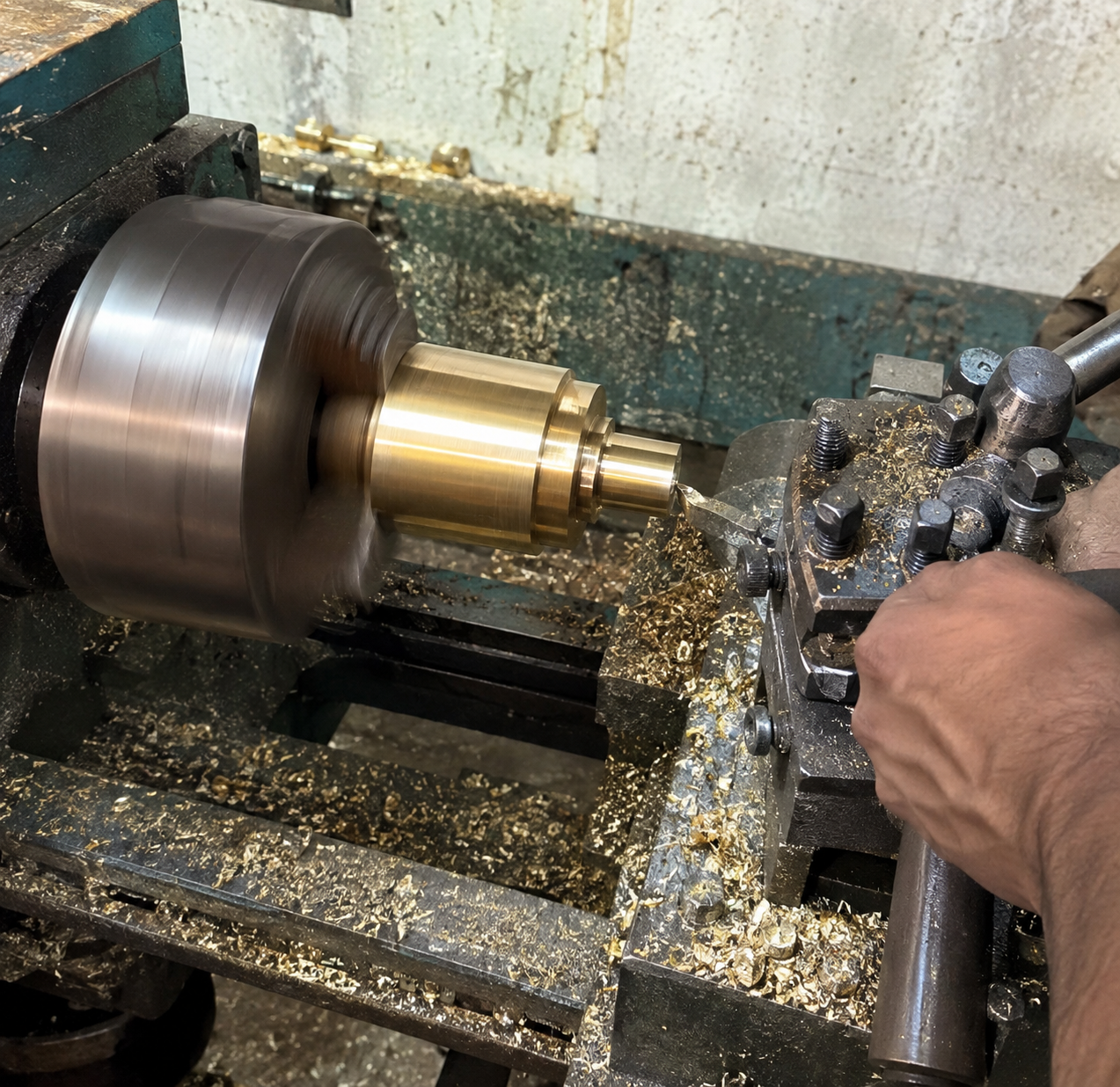
Turning & Shaping
Turning & Shaping is the stage where a cast brass form begins to find its character. Using a traditional lathe and the experienced hands of a skilled artisan, the rough form is carefully transformed into a balanced and refined shape.
Symmetry isn't measured here — it's felt, stroke by stroke, until the form finds its balance. Every movement of the cutting tool is deliberate, with the artisan constantly reading the metal and responding to its shape.
There are no shortcuts on this wheel; only patience, a steady hand, and years of knowing exactly when to stop.
Where Precision Meets Patience
Once the brass casting has cooled and been prepared, it is secured onto a lathe. The rotating motion allows the artisan to gradually refine the surface, remove excess material and establish the intended proportions.
The process requires an understanding that goes beyond measurements. The artisan learns to recognise the subtle changes in resistance, movement and balance, allowing the final form to emerge naturally.
Key Highlights
-
Traditional Lathe Work: Brass forms are carefully turned using skilled lathe techniques.
-
Hand-Controlled Precision: Every cut and movement is guided by the artisan's experience.
-
Balanced Proportions: The form is refined to achieve visual symmetry and proportion.
-
Smooth Form: Rough cast surfaces are gradually refined for the next stages.
-
Crafted For Further Detailing: The shaped form becomes the foundation for engraving, polishing and finishing.
Our Turning & Shaping Process
Each brass form passes through a controlled sequence of preparation, turning and refinement. The artisan gradually brings the desired shape out of the raw casting.
-
01. Preparing The Casting: The cast brass piece is inspected and prepared for turning.
-
02. Securing On The Lathe: The brass form is firmly positioned on the turning machine.
-
03. Initial Turning: Excess material is gradually removed to establish the basic profile.
-
04. Shaping: The artisan carefully refines curves, edges and proportions.
-
05. Surface Refinement: The surface is gradually prepared for polishing and decorative work.
-
06. Final Inspection: The finished form is checked for balance, shape and consistency before moving forward.
Why Turning & Shaping Matters
The shape of a handcrafted brass piece determines much of its visual character. A well-balanced form creates the foundation for every decorative detail that follows.
The artisan's ability to work gradually and precisely ensures that curves, edges and proportions remain harmonious. Even a small adjustment can change the character of the finished piece.
Once the form reaches its desired balance, it is ready to receive the next layers of craftsmanship — from Nakkashi and polishing to plating and hand-painted Meenakari.
The Artisan's Touch
“Symmetry isn't measured here — it's felt, stroke by stroke, until the form finds its balance.”
There are no shortcuts on this wheel; only patience, a steady hand, and years of knowing exactly when to stop.